Neptune
The windiest, coldest, and most distant planet in our Solar System
About Neptune
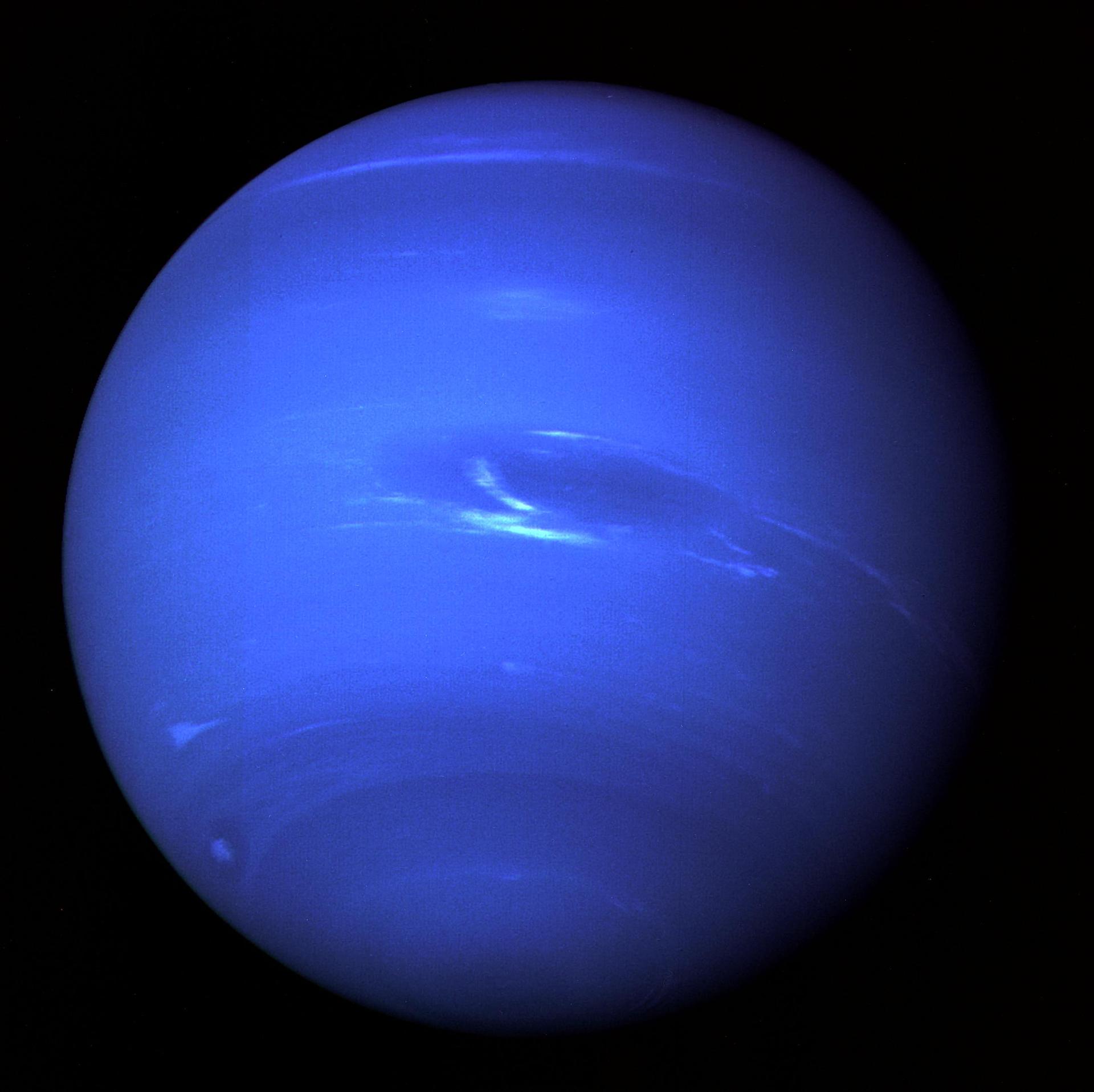
Neptune is the eighth and most distant planet from the Sun in our Solar System. It's the fourth-largest planet by diameter and the third-largest by mass, about 17 times the mass of Earth.
Neptune is known for its deep blue color, caused by methane in its atmosphere. It has the strongest winds in the Solar System, reaching speeds of up to 2,100 km/h (1,300 mph). A year on Neptune lasts about 165 Earth years!
Interesting Facts About Neptune
Windiest Planet
Neptune has the strongest winds in the Solar System, reaching speeds of up to 2,100 km/h (1,300 mph) - faster than the speed of sound on Earth!
Ice Giant
Neptune is classified as an "ice giant" along with Uranus, composed mostly of water, ammonia, and methane ices over a rocky core.
Triton's Strange Orbit
Neptune's largest moon, Triton, orbits in the opposite direction of Neptune's rotation and is slowly spiraling inward toward the planet.
Great Dark Spot
Similar to Jupiter's Great Red Spot, Neptune had a Great Dark Spot - an Earth-sized storm that disappeared when Hubble looked for it in 1994.
Spacecraft Exploration
Only one spacecraft has visited Neptune so far:
Voyager 2 (1989)
The only spacecraft to visit Neptune, Voyager 2 flew by in 1989, discovering six new moons, rings, and the Great Dark Spot storm system.
Hubble Space Telescope
Hubble has provided detailed observations of Neptune's atmosphere, storms, and ring system since its launch in 1990.
Future Missions
Several Neptune orbiter missions have been proposed by NASA and ESA, but none have been approved yet due to the long travel time (10-12 years).
How Neptune Compares
Size Comparison
Neptune is about 4 times wider than Earth. About 57 Earths could fit inside Neptune.
Distance Comparison
Neptune is so far from the Sun that sunlight takes over 4 hours to reach it, compared to 8 minutes for Earth.
Year Length
Since its discovery in 1846, Neptune has completed less than one full orbit around the Sun (it completes its first orbit in 2011).