Mars
The Red Planet - Humanity's next destination
About Mars
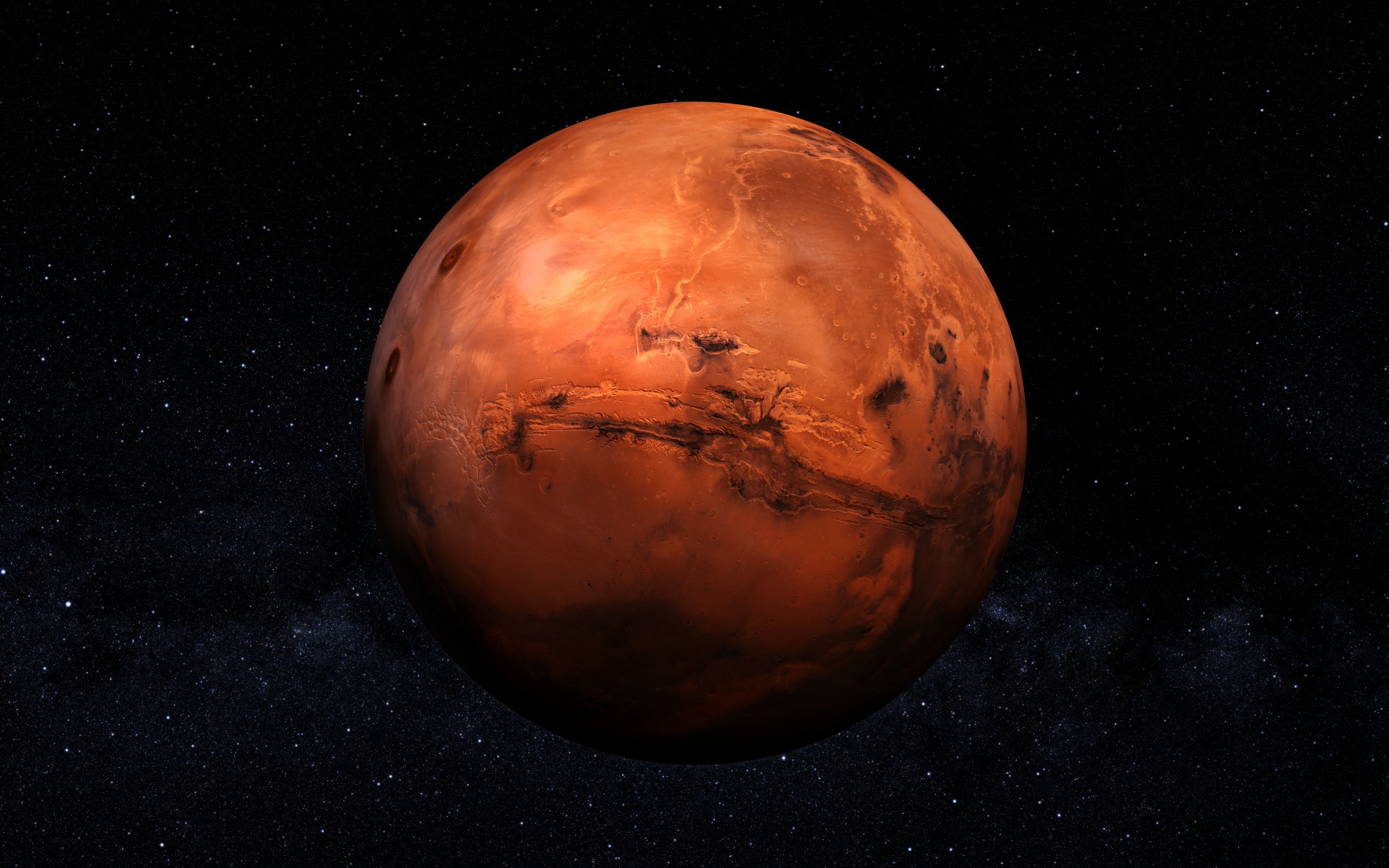
Mars is the fourth planet from the Sun and the second-smallest planet in the Solar System, often called the "Red Planet" due to its reddish appearance caused by iron oxide (rust) on its surface.
Mars is a terrestrial planet with a thin atmosphere, with surface features reminiscent of both the impact craters of the Moon and the valleys, deserts, and polar ice caps of Earth. It has the largest volcano and the deepest, longest canyon in the Solar System.
Interesting Facts About Mars
Tallest Mountain
Olympus Mons on Mars is the tallest mountain in the Solar System, standing at 21.9 km high - nearly three times taller than Mount Everest.
Water Ice
Mars has water ice at its poles and potentially underground. If all the ice melted, it could cover the planet's surface with an ocean 11 meters deep.
Longer Days
A day on Mars (called a "sol") is 24 hours and 37 minutes - very close to an Earth day. A year on Mars lasts 687 Earth days.
Massive Dust Storms
Mars experiences giant dust storms that can engulf the entire planet and last for months, sometimes raising enough dust to be visible from Earth.
Mars Exploration
Mars has been extensively explored by numerous spacecraft:
Rovers
Multiple rovers have explored Mars: Sojourner (1997), Spirit & Opportunity (2004), Curiosity (2012), and Perseverance (2021). Perseverance even carried the Ingenuity helicopter.
Orbiters
Currently, multiple orbiters study Mars from above, including NASA's Mars Reconnaissance Orbiter, MAVEN, and ESA's Mars Express and Trace Gas Orbiter.
Future Missions
NASA's Artemis program aims to land humans on Mars in the 2030s. SpaceX is also developing Starship for potential Mars colonization missions.
How Mars Compares to Earth
Size Comparison
Mars has about half the diameter of Earth and only about 15% of Earth's volume. Its surface area is roughly equal to Earth's total land area.
Gravity
Mars has only 38% of Earth's gravity. A 100 kg person on Earth would weigh only 38 kg on Mars.
Atmosphere
Mars' atmosphere is about 100 times thinner than Earth's and composed mostly of carbon dioxide (95%), making it inhospitable for humans without life support.
Mars' Moons: Phobos and Deimos
Phobos
The larger moon, Phobos, orbits just 6,000 km above Mars and is slowly spiraling inward. It will either crash into Mars or break apart in about 50 million years.
Deimos
The smaller moon, Deimos, orbits much farther out. Both moons are irregularly shaped and are thought to be captured asteroids.