Jupiter
The largest planet in our Solar System - The Gas Giant
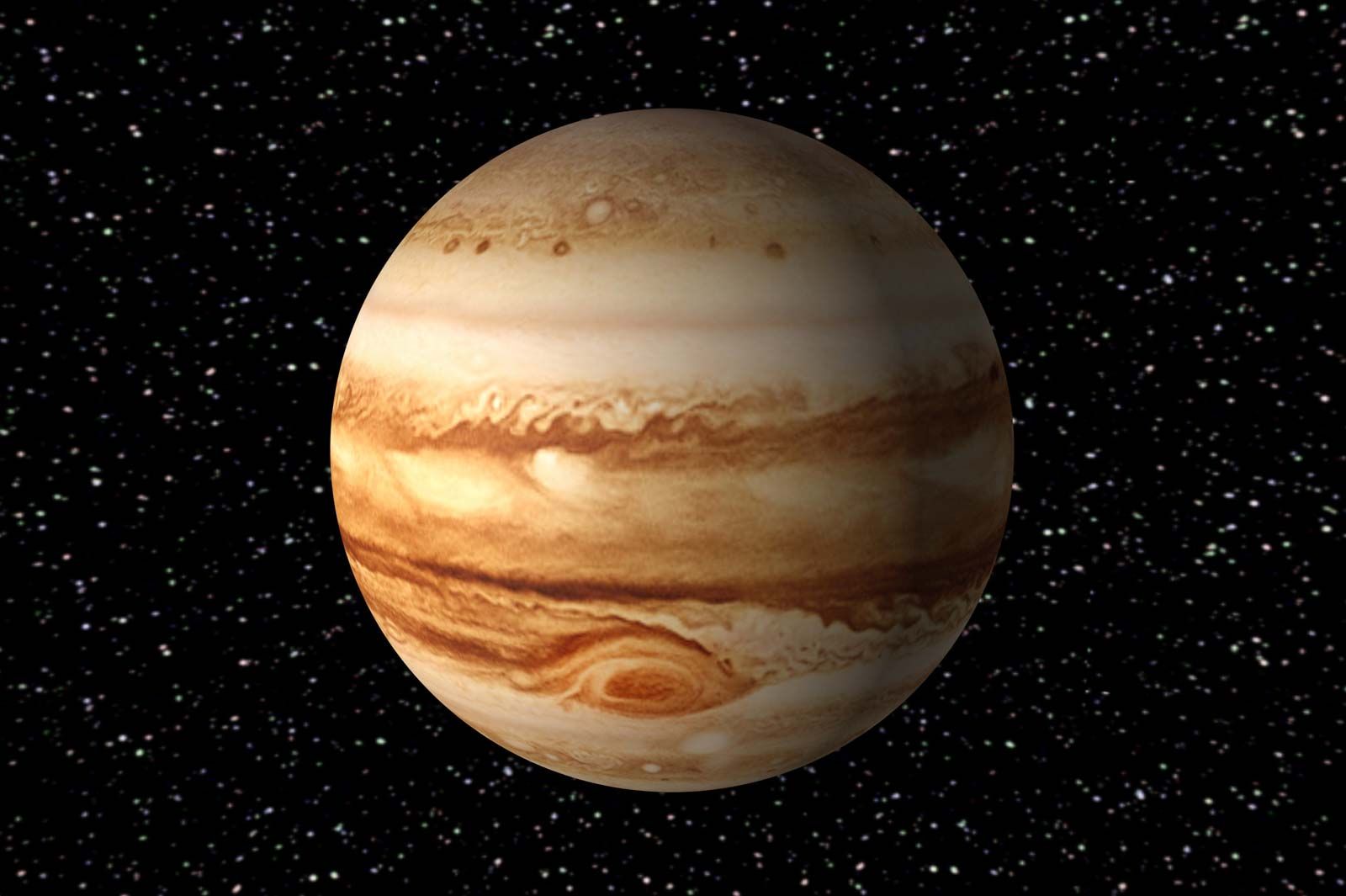
About Jupiter
Jupiter is the fifth planet from the Sun and the largest in the Solar System. It is a gas giant with a mass more than two and a half times that of all the other planets in the Solar System combined.
Jupiter is primarily composed of hydrogen and helium. The planet's iconic Great Red Spot is a giant storm that has been raging for at least 400 years. Jupiter has a faint ring system and at least 95 known moons, including the four large Galilean moons: Io, Europa, Ganymede, and Callisto.
Interesting Facts About Jupiter
The Great Red Spot
Jupiter's Great Red Spot is a gigantic storm that has been raging for at least 400 years. It's so large that three Earths could fit inside it.
Planetary Protector
Jupiter's massive gravity protects Earth by deflecting or capturing many comets and asteroids that might otherwise threaten our planet.
Failed Star
Jupiter is often called a "failed star" because it's composed of similar elements to the Sun, but it's not massive enough to sustain nuclear fusion.
Moon King
Jupiter has the most moons of any planet in our Solar System, with at least 95 confirmed moons and many more waiting to be discovered.
Spacecraft Exploration
Several spacecraft have visited Jupiter:
Pioneer 10 & 11 (1973-1974)
The first spacecraft to visit Jupiter, providing the first close-up images and data about the planet's radiation belts and magnetic field.
Voyager 1 & 2 (1979)
Revealed Jupiter's rings, discovered volcanic activity on Io, and provided detailed images of the Galilean moons.
Galileo (1995-2003)
NASA's Galileo spacecraft orbited Jupiter for 8 years, studying the planet and its moons in unprecedented detail, including dropping a probe into Jupiter's atmosphere.
Juno (2016-Present)
Currently orbiting Jupiter, studying the planet's composition, gravity field, magnetic field, and polar magnetosphere to understand its formation and evolution.
How Jupiter Compares
Size Comparison
Jupiter is so massive that over 1,300 Earths could fit inside it. It's 11 times wider than Earth.
Fast Rotation
Despite its enormous size, Jupiter has the shortest day of all planets, rotating once every 9.9 hours.
Mass Dominance
Jupiter's mass is 2.5 times greater than all the other planets in the Solar System combined.
Powerful Magnetic Field
Jupiter has the strongest magnetic field of any planet, about 20,000 times stronger than Earth's.