Venus
Earth's "sister planet" and the hottest planet in our Solar System
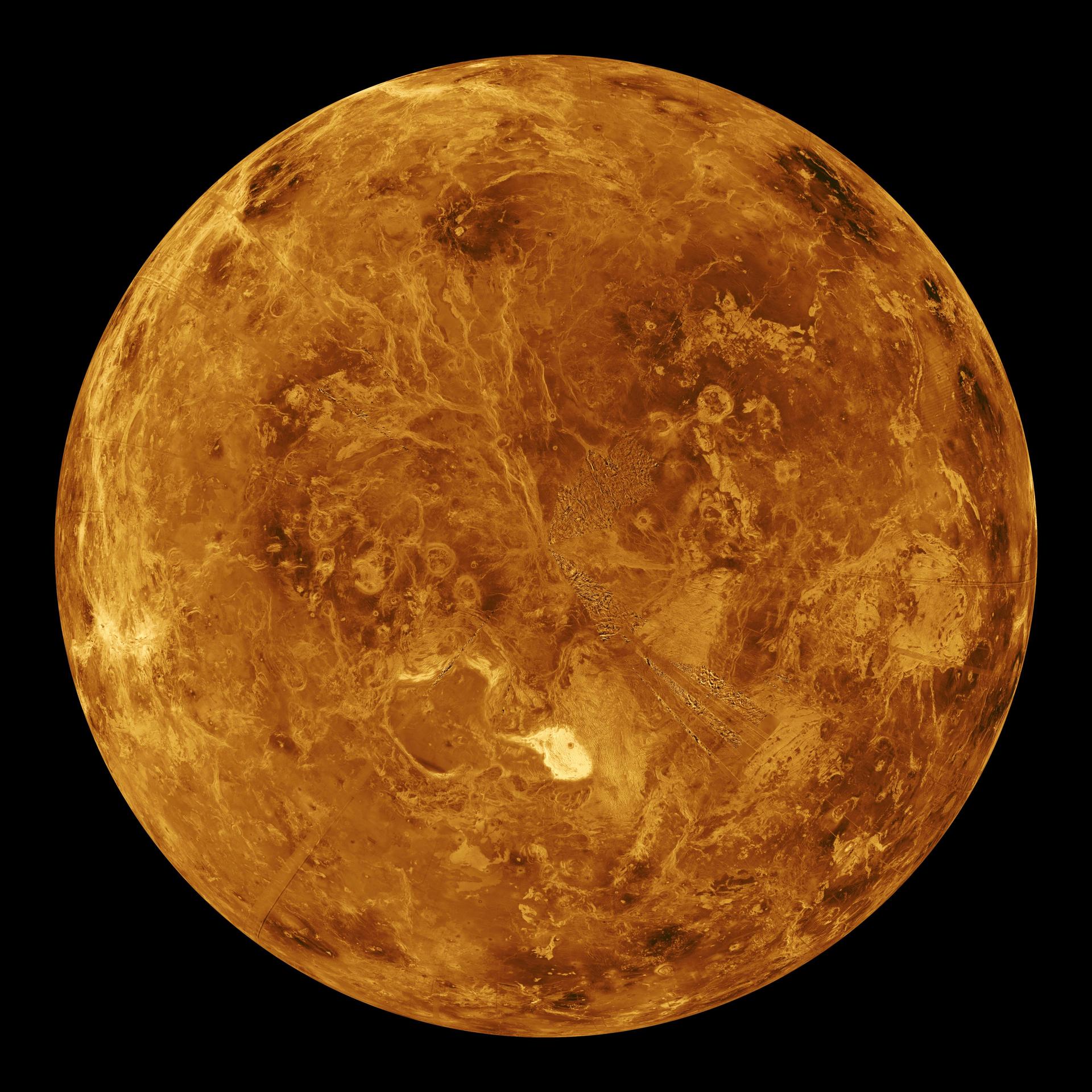
About Venus
Venus is the second planet from the Sun and is often called Earth's "sister planet" because of their similar size, mass, and composition. However, that's where the similarities end.
Venus has the densest atmosphere of the four terrestrial planets, consisting of more than 96% carbon dioxide. The atmospheric pressure at the planet's surface is about 92 times that of Earth's sea level.
Venus is shrouded by an opaque layer of highly reflective clouds of sulfuric acid, preventing its surface from being seen from space in visible light. It has the hottest planetary surface in the Solar System, with a mean temperature of 464°C (867°F).
Interesting Facts About Venus
Hottest Planet
Despite being further from the Sun than Mercury, Venus is the hottest planet in our Solar System due to its extreme greenhouse effect.
Retrograde Rotation
Venus rotates in the opposite direction to most planets in our Solar System. A day on Venus is longer than its year!
Acid Clouds
Venus is covered in thick clouds of sulfuric acid that reflect about 75% of sunlight, making it the brightest natural object in Earth's night sky after the Moon.
Volcanic World
Venus has more volcanoes than any other planet in our Solar System, with over 1,600 major volcanoes or volcanic features.
Spacecraft Exploration
Venus has been visited by numerous spacecraft since the 1960s:
Venera Program (1961-1984)
A series of Soviet spacecraft that achieved many firsts: first to enter another planet's atmosphere, first soft landing, and first images from the surface.
Magellan (1989-1994)
NASA's Magellan spacecraft mapped 98% of Venus's surface using synthetic aperture radar to penetrate the thick clouds.
Current Missions
JAXA's Akatsuki (2015-present) studies Venus's atmosphere, and upcoming missions include NASA's VERITAS and DAVINCI+ (planned for 2029-2030).
How Venus Compares
Earth's Twin
Venus is often called Earth's twin because it's similar in size (95% of Earth's diameter) and mass (81% of Earth's mass).
Extreme Pressure
The pressure on Venus's surface is equivalent to being 900 meters (3,000 feet) underwater on Earth - enough to crush a submarine.
Morning & Evening Star
Because its orbit is inside Earth's, Venus appears as either a "morning star" or "evening star" and is the brightest planet in our sky.